
Experts
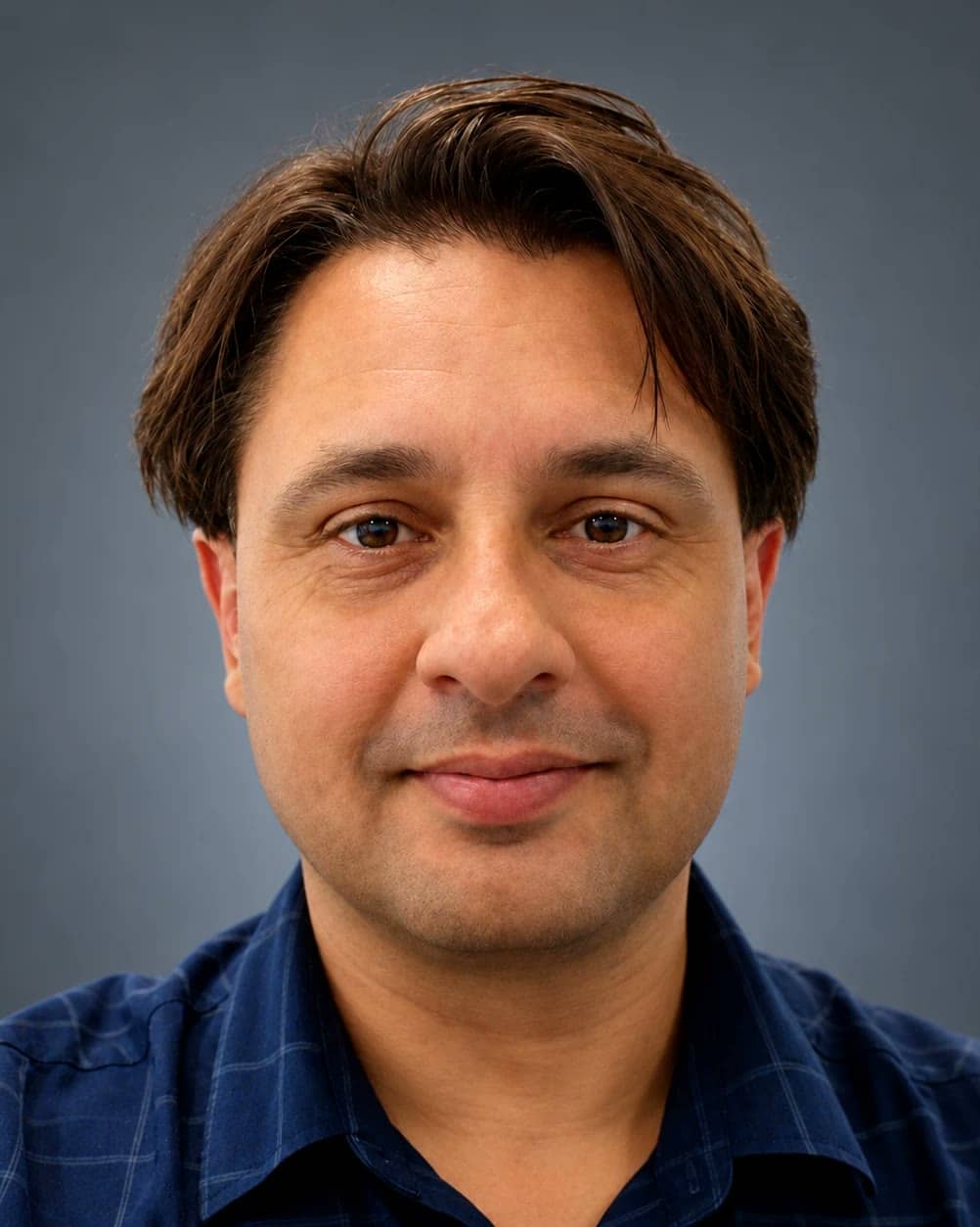
Professor Arkadiusz Sitek
Physicist and healthcare AI researcher · AI and Bayesian methods trained and developed at Massachusetts General Hospital and Harvard Medical School
- MSc Physics
- PhD Physics
- Inventor on more than ten granted US patents
- Member, International Society for Bayesian Analysis
Arkadiusz Sitek is a physicist and healthcare AI researcher. Trained in physics in Warsaw and Vancouver, he spent the first part of his career in nuclear medicine physics: his doctoral work produced a SPECT attenuation-correction system later adopted by a major scanner manufacturer, and he went on to develop factor analysis of dynamic structures, Bayesian kinetic modelling and the origin-ensemble reconstruction framework, summarised in his monograph Statistical Computing in Nuclear Imaging (2014).
Over more than a decade at Harvard Medical School, Brigham and Women's Hospital and Massachusetts General Hospital he built the quantification methods behind highly cited work on myocardial perfusion PET and coronary flow reserve. He then led machine-learning research teams at two global health-technology companies, where he is a named inventor on a series of granted medical-imaging AI patents, and returned to Poland as the inaugural director of a national centre for computational medicine in Kraków, which he grew from 11 to 70 staff.
Since 2022 his research at Massachusetts General Hospital has centred on generative and foundation models for electronic health records, including a transformer that predicts health trajectories without task-specific training and adaptive risk estimation, together with deep learning for fetal ultrasound and surgical video and open data standards for health AI. He co-authored best-practice guidance on AI algorithm development in nuclear medicine and a 2026 perspective on generative AI as a general computing model for medicine.
Through Veritas Clinical Innovations he leads the AI-driven data analysis service, applying his proprietary Bayesian and machine-learning methodology to clients' clinical, imaging and registry data, and advises on the design and validation of AI tools in clinical research, in an independent, personal capacity.
Areas of focus
- Machine learning and generative AI for clinical data
- Foundation models of electronic health records
- Bayesian and statistical computing in medical imaging
- Quantitative PET and SPECT and cardiac imaging
- Computer vision for ultrasound and radiology
- Validation, reliability and fairness of clinical AI
- Health data standards and open science
Selected honours
- Author of Statistical Computing in Nuclear Imaging, CRC Press (2014)
- Named inventor on more than ten granted US patents in medical-imaging AI (2012–2024)
- Principal investigator of National Institutes of Health and American Heart Association awards in cardiac imaging (2007–2013)
- Co-author of the SNMMI and EANM best-practice guidance on AI algorithm development in nuclear medicine (2022)
- Inaugural director of a national centre for computational medicine, Kraków (2021–2022)
- h-index 40 with more than 6,900 citations (Google Scholar, 2026)
Professional advice through Veritas Clinical Innovations is provided independently by the named experts. It does not represent, and is not endorsed by, any university, journal, professional society or employer with which they are or have been associated. Institutional roles are therefore not listed on these pages.